The NCERTTrap:
Biology Edition
Read Here
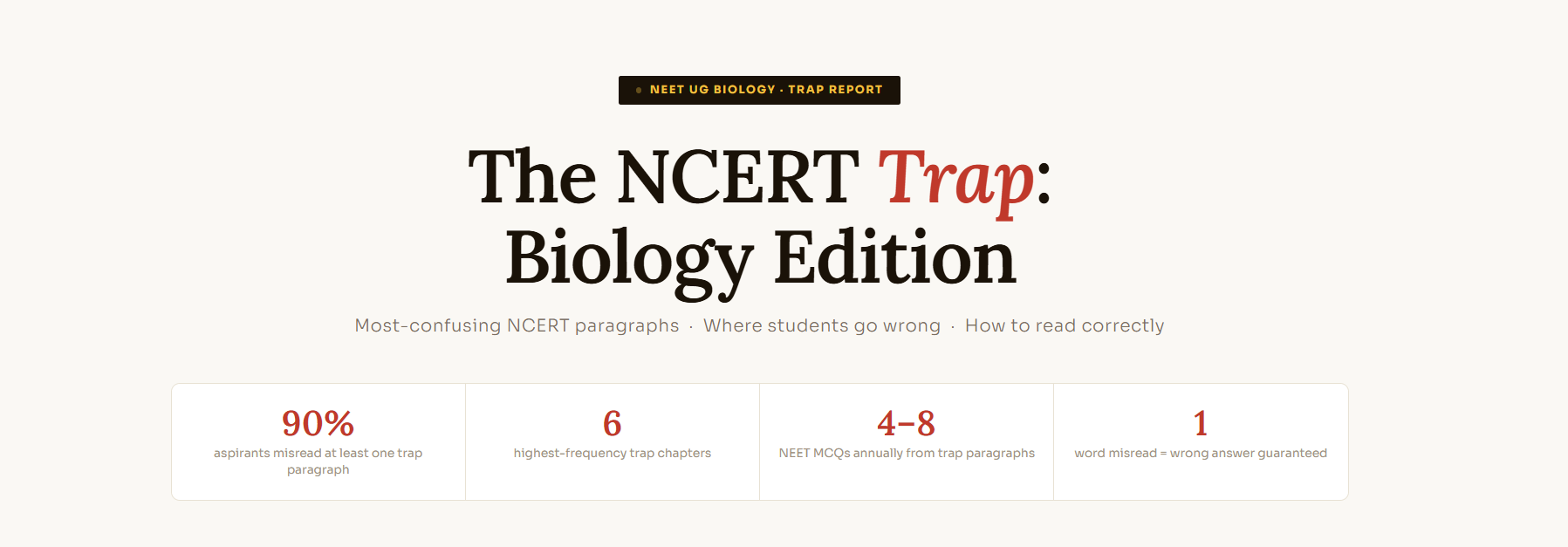
The NCERT Trap in Biology (NEET 2026 Guide)
Most Confusing NCERT Paragraphs Explained — Stop Losing Easy Marks
NCERT Biology traps, NEET Biology mistakes, Meiosis vs Mitosis NEET, NCERT line-by-line analysis, Class 11 Biology Cell Cycle
Why This NCERT Trap Matters for NEET Aspirants
90% of NEET aspirants misinterpret at least one NCERT trap paragraph
6 high-frequency trap chapters repeatedly tested in NEET
4–8 MCQs every year directly come from these lines
1 misread word = guaranteed wrong answer
High-Weightage Trap Chapters:
Cell Division
Genetics & Inheritance
Photosynthesis
Human Reproduction
Evolution
Excretion
The Exact NCERT Trap (Class 11 Biology, Chapter 10 – Cell Cycle & Division)
“Mitosis results in the production of diploid daughter cells with the same genetic complement as the parent cell. Meiosis, on the other hand, reduces the chromosome number to half. In meiosis I, homologous chromosomes separate, whereas in meiosis II, sister chromatids separate — similar to mitosis. The ploidy level of cells changes only at meiosis I, not at meiosis II.”
Why Students Get This Wrong (Data-Driven Insight)
| Mistake Pattern | % of Students Affected |
|---|---|
| Meiosis II = Mitosis confusion | 88% |
| Homologous vs Sister Chromatid mix-up | 81% |
| Wrong ploidy change timing | 76% |
| Misinterpreting “reduces to half” | 65% |
Where Exactly Students Go Wrong
Misinterpreting “Meiosis II is similar to mitosis”
→ Students assume Meiosis II produces diploid cells
→ Reality: Cells are already haploid before Meiosis II begins
Oversimplifying “Meiosis halves chromosomes”
→ Happens only in Meiosis I, not both divisions
Swapping key biological terms
→ Meiosis I: Homologous chromosomes separate
→ Meiosis II: Sister chromatids separate
Ignoring the keyword “ONLY”
→ “Ploidy changes only at Meiosis I”
→ This line alone can form a direct NEET MCQ
Correct Concept (High-Retention Framework)
Step 1: Separate the Two Divisions Clearly
Meiosis I → Reduction Division (2n → n)
Meiosis II → Equational Division (n → n)
Step 2: Understand the Comparison Properly
“Similar to mitosis” refers to:
Mechanism → ✔ Yes (chromatid separation)
Ploidy outcome → ❌ No
Step 3: Lock This Table in Memory
| Feature | Meiosis I | Meiosis II |
|---|---|---|
| Type | Reduction | Equational |
| Chromosome Change | 2n → n | n → n |
| What Separates | Homologous Chromosomes | Sister Chromatids |
| Ploidy Change | Yes | No |
Proven NCERT Reading Strategy for NEET
Watch for contrast words
→ “on the other hand”, “whereas” → always MCQ zones
Circle the word “ONLY”
→ In NCERT, this often becomes the correct answer
Never read comparisons passively
→ Always ask: similar in what exactly?
Focus on last lines of paragraphs
→ NCERT hides high-value facts at the end
Convert paragraphs into tables
→ Tables improve retention and reduce confusion
NEET-Level MCQ Traps from This Paragraph
Q1. When does chromosome number reduce to half?
✔ Correct: Meiosis I (Anaphase I)
❌ Trap: Writing “Meiosis” generally
Q2. What is true about Meiosis II?
✔ Correct: Separates sister chromatids (like mitosis in mechanism)
❌ Trap: Saying it reduces chromosome number
Q3. What separates in Meiosis I vs II?
✔ Meiosis I → Homologous chromosomes
✔ Meiosis II → Sister chromatids
❌ Trap: Interchanging them
Core Concept (The Real NCERT Trap)
NCERT compares Meiosis II with mitosis, but only in terms of mechanism.
Most students mentally simplify it to:
“Meiosis II = Mitosis”
This leads to:
Wrong ploidy assumptions
Wrong stage answers
Incorrect MCQ choices
Fix: Always define what exactly is being compared.
Final Takeaway for NEET 2026
If you master how to read NCERT, not just what to read, your accuracy will jump significantly.
NEET is not testing knowledge alone — it tests precision reading of NCERT lines.
About the Author
Asfak Hossain
NEET Zoology Specialist
Persue Institute
Helping students decode NCERT Biology for maximum NEET accuracy.
NEET Biology mistakes, NCERT traps Biology, Meiosis vs Mitosis NEET, Cell Cycle NEET questions, NCERT line analysis, NEET 2026 Biology strategy, Class 11 Biology important lines
by Asfak Hossain · NEET Zoology Specialist · Persue Institute · asfakhossain.in